
Today’s article is inspired by the book The Slight Edge by Jeff Olson.
Before we start, let’s define our terms…what is Edge?
Here, having an Edge means holding an advantage or a slight superiority over competitors (e.g., “She has an edge in the competition”).
Trader’s edge is a concept from financial markets.
Let us say that an investor or a trader has an edge in the market. They have some special sauce, a trading or investment system that allows them to beat the market over the long run.
Sure they won’t make profits every day or on every single trade. But their edge means that they might win ~55 times and lose ~45 times out of each hundred.
You won’t find traders with a real edge advertising their FX trading or option trading courses on Youtube. If they really had an edge, they would shut up and trade it. They’d keep their secrets and quietly milk the cow.
On a long enough timeframe, the person with an edge wins.
Hence the expression, The House always wins. That’s because the casino has An Edge. An edge is the inbuilt advantage that tilts the odds in your favour (if you own the casino) or against you (if you’re a punter).
There is a huge difference between gambling if you are the casino versus if you are a punter. The casino owner doesn’t really care if the next spin of the wheel comes up red or black. Win some, lose some. They just want lots of punters in the casino betting on as many spins of the roulette wheel as possible.
In roulette, the casino’s Edge is provided by the zero(s) on the wheel. Imagine a roulette wheel with 37 slots, 36 numbers and a zero.
If you are betting on Red or Black, you lose if the ball lands on the (green) zero. So if you bet $100 on Red your payoffs are to win $200 18 times out of 37 and to lose $100 19 time out of 37. So the expected return on a $100 bet is $97.3 :
((19/37) x 0) + ((18/37) x 200) = 97.3
It’s a negative expected value trade because the playing field is tilted in favour of the casino.
If you placed $1 bets on all the numbers (including 0) you would definitely “win” but it would cost you $37 and you’d only get back $36. The one dollar profit is the casino’s slight edge.
Every day, you face a fork in the road…actually, many times a day.
You choose between a simple productive action (easy to do) and its neglect (easy not to do).
Every day you need to take care over those simple little actions which, compounded over time, will make the difference between your success or failure.
These tiny decisions— saving a bit more, reading good books, exercising, eating clean, cultivating relationships, expressing gratitude—seem insignificant in the moment, yet repeated over time, they create exponential results via compounding, much like compound interest in finance.
Conversely, small errors and omissions (e.g. skipping the gym, limiting beliefs, procrastination) compound into failure.
The slight edge is relentless and it can cut either way, as James Clear illustrates below:

Imagine that following a trading strategy with a Slight Edge could get you 1% better each day…you started with $1 and by the end of the year you have got $37.78. You multiplied your net worth by a multiple of 38x.
Conversely, if you are getting 1% worse every day, over the course of a year you will turn $100 into $3.
You may say that this timetable is unrealistic. Fine, you can use one week or one month or one year as the period over which you get 1% better…the same principles apply.
To keep doing the right thing, we must master the mundane.
Most people overlook or disdain basics—like trying their best at work, showing up for the gym, spending less than you earn, and doing “The Thing”.
For success we must embrace the unsexy: the consistent execution of fundamentals. An “apple a day” philosophy keeps the doctor away not through excitement, but through repetition.
How long will it take? How long before you will actually see and feel (or be able to spend) the results?
Obviously it depends. It depends on what you are trying to achieve, how disciplined you are and how lucky you get.
Chances are it will take you longer than you want it to…and that when the time comes, you’ll be astonished at how quick it seemed.
According to Olson: “in my experience, in three to five years you can put virtually anything in your life solidly onto the right track”.
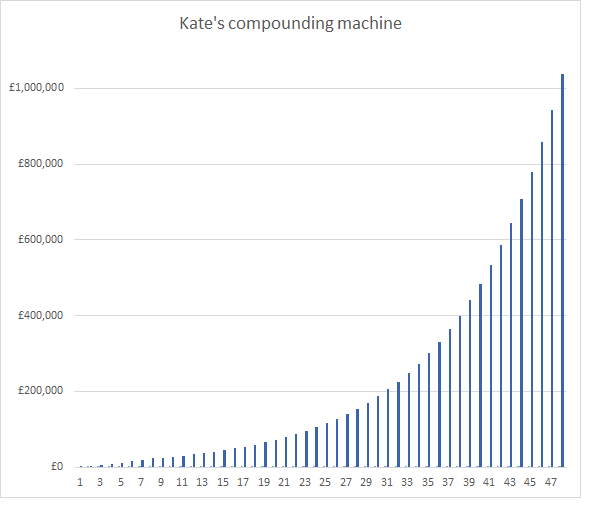
In my experience, compounding feels like nothing much is happening for the first 5 years. But after that, you start to see it working. And after 20 years, things start to get really interesting:
Everything has a natural timeline: farmers understand that it takes time to plant, cultivate, harvest.
Rushing things and expecting overnight riches, only leads to gambling and the lottery ticket buyer’s mentality. Small disciplines require patience; results emerge gradually.
Once we have an edge, we have to trust the process rather than demanding instant transformation. What feels slow initially accelerates later through compounding. Hurrying often leads to burnout, while steady pacing ensures sustainability.
How can you be happy whilst sticking at something difficult for 5 years?
I’m so glad you asked. By complete co-incidence, I’d wanted to talk to you about that.
You’re not going to do the right actions, day in and day out, unless you have the right philosophy, the right mindset, the right psychology.
First you have to understand the idea of The Slight Edge…and then you have to be happy.
Wait what? Why does Olson want us to be happy?!?
Olson realised that, whilst the slight edge was the missing ingredient people need to make their lives work, happiness was the missing ingredient that people needed to make the slight edge work.
In other words, the slight edge approach requires patience and it needs time for the results to become obvious enough for us to trust the process. And you can be much more patient when you are happy. When you’re happy it’s fine if it takes a bit longer.
Olson draws on the field of positive psychology and the work of Martin Seligman to answer the question: what actually makes us happy?
Here is the answer to Life, The Universe and Everything. Are you ready?
Okay, so maybe that was a little bit of an exaggeration, but here’s how to be happy (or happier):
- Each day, write down three things you’re grateful for
- Get at least one good thing done every day (random acts of kindness count)
- Exercise daily (even if just walking)
- Cultivate your relationships
- Relax and focus each day (some people call this “meditation”)
- Read at least 10 pages of a good book daily
The slight edge requires you to Invest In Yourself.
Olson advocates continuous learning: seeking out knowledge that can be applied, reading the best books on personal development and pursuing lifelong learning.
The wisest investments compound your personal capability. Olson highlights how guidance from books, coaching, mentors etc can accelerate your growth (without replacing personal responsibility).
How do you get your finances on a sustainable path to wealth?
You make sure that you have a system that incorporates a slight edge.
Earning more than you spend gives you an edge. Waiting 24 hours before making any large purchase is (part of) a system. Paying yourself first each month is a system. Tracking your spending is a system.
Paying your utility bills and any credit cards off in full automatically each month is a system. Putting aside tax money each month in your business is a system.
Dollar cost averaging into a global equities tracker fund on autopilot each month is a system. Having a target asset allocation is a system. Using tax shelters (pensions, ISAs etc) is a system.
Fees charged by wealth managers, fund managers and platforms are a negative edge for investors. So you have to get those fees as low as possible.
First you have to get an effective system in place. Then you have to trust the system and stick to it.
If you do something every day for a month (31 days in a row) it will start to become a habit. Things done monthly take longer, obvs.
If you are serious about a goal, you need to put it out there. If you tell the world (or at least tell someone you trust) what you are doing, you are more likely to stay the course.
Once you start, the new good habit, you will have literally begun to wire your brain to see the world in a different way. And, as a result, you should be happier on an day to day basis.
Happy investing!
Barney
If you’d like to discuss financial coaching or career coaching, please set up an introductory call with me here.
You can save a life by sharing this article with a friend or family member

 The Escape Artist