

If you want to be a free man (or woman), if you want to be citizen of Rome (rather than a slave) you need to be able to say no to your boss.
This is best illustrated with a concept that I first stole learned from Nasim Taleb’s book Fooled by Randomness (although it’s appeared in multiple places and I suspect Taleb himself probably stole it from someone else).
That is the concept of Fuck You money.
If you are a Wall Street trader (or other degenerate) this can be defined as the amount of money that it takes to scream FUCK YOU! down the phone at your boss.
Or to just politely say no.
Both can be career limiting. Both kinda amount to the same thing if you focus on the substance rather than the style.
This is the position of Fuck You.
Re-watching this video again recently, I noticed something new (or rather something that I hadn’t noticed before).
Something relevant to the idea of early retirement.
In the clip, John Goodman is financially bombproof. He has a $2.5 million net worth including a paid off house and a low cost lifestyle with a reliable Japanese second-hand car.
[This advice to buy a reliable second hand Japanese car with minimal maintenance costs is sound financial advice that I have been flagrantly violating recently…this may be the subject of a future article].
I am not sure how seriously John has been taking his health. But, to be fair, he advises quitting alcohol even though he apparently still partakes himself.
What John does <NOT> recommend is stopping working to do nothing. His advice implies still having a boss that you can say “fuck you” (or “no, thanks”) to. Or being self-employed and working for yourself.
When you are financially independent, you have to ask yourself the question: what should I now do with my life?
Here we get to the nub of the issue.
What is it all for? What is the point of all the saving and investing…if not to avoid work?
What are we deferring gratification for?
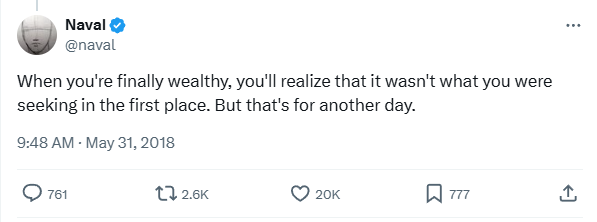
My answer? We are doing it for the ability to say no.
The ability to say no is one of the main benefits of financial freedom. And many of these benefits can be achieved with less money than people often think.
That’s because if you are willing to be brave, say no and be ready to walk away you don’t need enough money to never work again.
Yes, we know that if you have a $1,000,000 in a global equities index tracker and a paid off home, you can live off $40,000 per year, never work again and (almost certainly) never run out of money. That is the basic maths of financial independence.
But what if you didn’t need that much to be able to say no?
You just need enough financial runway to negotiate effectively with your boss. That means being able to say No (and perhaps to walk away).
To illuistrate, here is a 100% true story from a recent coaching client
My client was (and remains) a senior and highly educated nurse in Britain’s once-glorious National Health Service.
Despite modest pay, she is on the path to financial independence. And, thanks to some brave investing decisions, she is now getting tantalisingly close to being able to walk away.
Like many of the people that I talk to, her desire to save aggressively was super-charged by increasing workplace stress.
She had been reaching her limit with burnout and wanted to discuss her exit plan from The NHS Prison Camp.
As an outsider, it looked to me like the NHS was just about working (albeit creaking at the seams) up until Covid. Since then, not so much.
The community nursing team that my client worked for seems to have fallen apart from a combination of increased demand from dysfunctional and mentally ill patients, increased burnout, colleagues on long term sick leave, a shortage of nurses etc etc
Just one example: One of her colleagues (a female nurse) had to deal on her own with a mentally ill male patient who pulled a knife on her.
Understandably, after that the nurse then refused to visit or see that patient alone.
The administrator bosses told her she would have to put the interests of the patient first, see the patient alone again OR FACE DISCIPLINARY MEASURES.
To me, there is an easy response to this:
If I were the nurse, I would JUST SAY NO.
I would capture an email trail (and print out the evidence) and be ready to take that to an employment tribunal and / or newspaper if the bureaucrat followed through with their threat.
My bet would be that the bureaucrat administrator was bluffing and would ultimately have to back down from their threat.
After all, bureaucrats are not known for their bravery or willingness to take career risk.
I would like to say that I would say NO (and stick to it) in all circumstances.
But there have been many times in my career when I couldn’t afford to lose my job.
Question: When you have 3 children and are the sole breadwinner…what are you gonna do if the boss says jump?
Answer: politely enquire how high?
All spending commitments (credit card payments, car leases, private school fees, mortgage payments) have the same effect: they reduce your ability to say NO THANK YOU.
When you are burned out, it’s hard to think clearly and make smart decisions. It becomes harder to set boundaries and effectively police those boundaries.
This is why a cash emergency fund (of say 3-6 months spending) sits as the base layer of a portfolio, the foundation of your financial fortress.
Six months’ emergency expenses means not being terrified of your boss, because you know you won’t be ruined if you have to take some time off to find a new job.
The more runway you have, the safer you are.
What is your runway?
To calculate your “runway”, you first calculate your net worth. This is the total of your financial assets minus any debts. (If you wanted to be prudent you could exclude your house and pension from the calculation to arrive at accessible net worth).
Then you divide your net worth by your “burn rate”. Your burn rate is your non-discretionary spending. It’s the amount you need to keep the lights on, pay taxes, meet the mortgage payments, feed yourself and your family and generally keep the show on the road. This does not need to include holidays, luxuries or other stuff you have a choice over whether to spend or not.
So if you have savings of £100,000 and an annual burn rate of £20,000, you have a 5 year runway.
You get more runway (more financial security) either by getting more or spending less.
The amount of money required for this will vary from person to person depending on agreeableness, risk appetite, liabilities and spending commitments. High spenders, Nice Guys and Scaredycats all need more to be able to say no.
But I have realised from speaking to many different people on the journey to financial freedom that the amount needed is much less if you have good health, confidence and mojo.
And no amount of money is enough to feel secure…without the health, the energy and – dare I say it? – the balls to say no.
Maybe that was what you were seeking in the first place?
Love to everyone
Barney
New articles appear first on my Substack : https://theescapeartist1.substack.com/
If you’d like to discuss career coaching or financial coaching, please set up an introductory call with me here.

 The Escape Artist